
Vienna street photography brings imperial architecture and everyday life into one frame: musicians, performers, skaters, reflections, historic squares and candid human moments across one of Europe’s most photogenic cities. This short photography guide will show you best of Vienna.
Vienna is often photographed as a city of palaces, opera houses, churches and carefully preserved imperial architecture. Yet its real photographic character appears when those monumental backgrounds meet the unpredictable rhythm of everyday life.
A pedestrian crosses the street in front of the Vienna State Opera. A musician begins playing in a busy shopping street. A skateboarder rises above the pavement for a fraction of a second. A street performer attracts a circle of curious strangers. A carriage driver pauses between rides. Rainwater transforms historic buildings into temporary reflections.
This is the true magic of street photography in Vienna.
The city offers much more than classical postcard views. Its historic centre is a constantly changing stage where architecture, movement, music, fashion, tourism and ordinary daily routines overlap. For photographers, every walk can produce a completely different visual story.
Imperial Vienna as a Street Photography Background
Few European cities offer such an impressive architectural setting for candid photography.
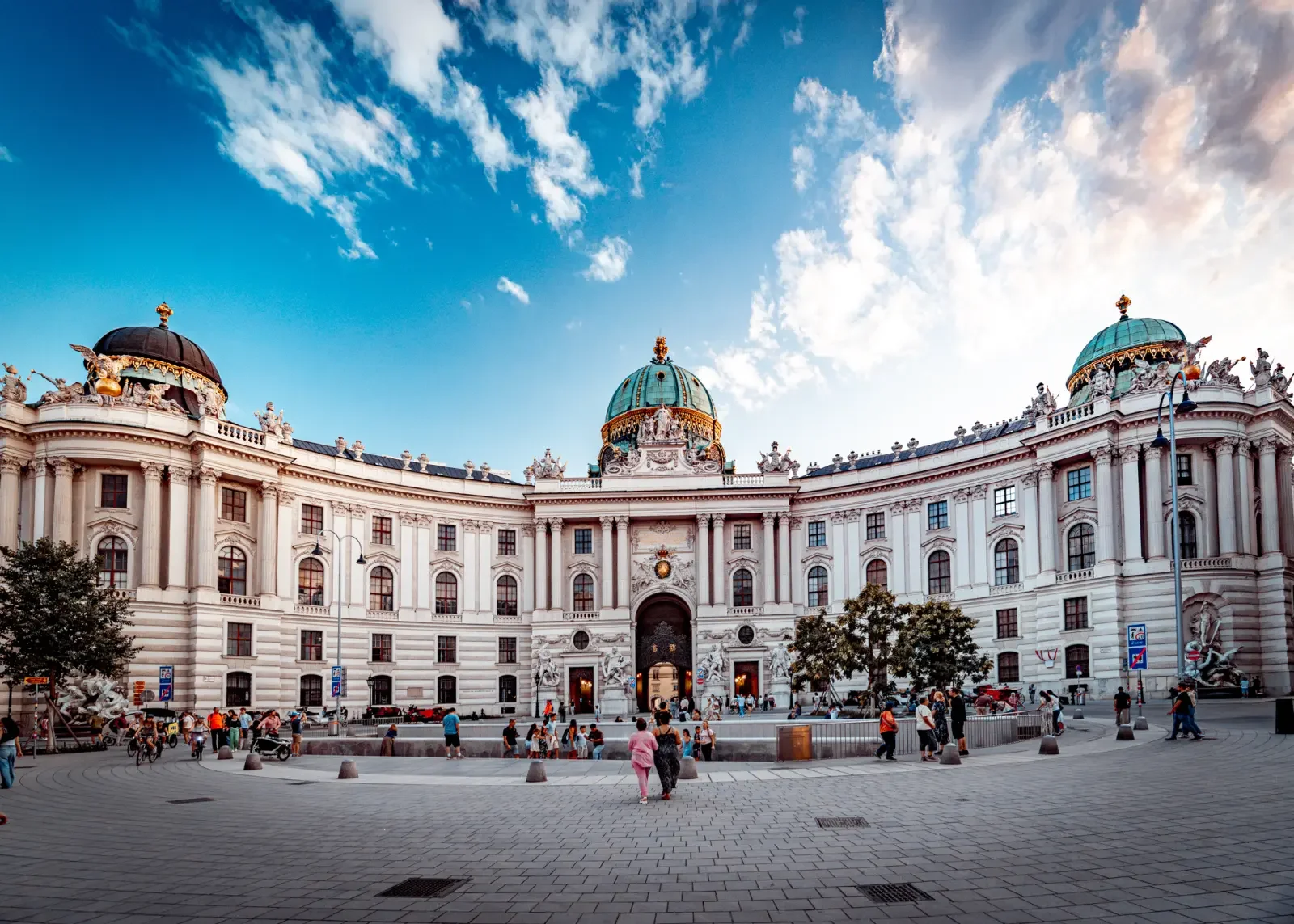
Around Michaelerplatz, the curved façade of the Hofburg, the dome of the Michaelertrakt and St. Michael’s Church create one of Vienna’s most recognizable historic compositions. Yet the square becomes most interesting when people enter the frame: pedestrians crossing between buildings, horse-drawn carriages waiting for passengers, cyclists passing through and visitors stopping to understand the scale of the surroundings.
A wide panoramic composition can show the complete architectural scene, while a lower camera position can transform the same location through a reflection in a rain puddle.
From Kohlmarkt, the Hofburg dome appears at the end of a busy pedestrian corridor. Luxury shops, street lamps and crowds create natural visual layers leading toward the imperial architecture. During blue hour, illuminated façades and warm shop windows add depth and colour, while slower shutter speeds can turn moving pedestrians into a gentle flow through the frame.
Vienna’s history never disappears from these photographs. It remains present behind every modern movement.
Dynamic City Movement Around the Vienna State Opera
The area around the Vienna State Opera is especially rewarding for photographers interested in movement.
Pedestrian crossings, trams, cars, cyclists and visitors create a constant rhythm around one of the city’s most famous cultural landmarks. The architecture gives the image structure, while the people provide timing, gesture and unpredictability.
A fast shutter speed can isolate one decisive moment. A slower exposure can transform groups of pedestrians into blurred figures moving through an otherwise sharp architectural scene. Both approaches tell a different story about the same place.
Rain can make the location even more visually interesting. Small puddles below arcades or along the Ringstrasse can reflect illuminated façades, street lamps and passing figures. Instead of avoiding wet weather, street photographers can use it to discover compositions that do not exist on dry days.
Vienna after rain often becomes two cities at once: the physical city above and its temporary reflected version below.
Street Musicians Bringing World-Class Music to the City
Vienna’s musical identity is not limited to opera houses and formal concert venues.
In the historic centre, especially around Kärntner Straße, Graben and Stephansplatz, street musicians regularly transform public space into an open-air stage. Acoustic guitarists, singers, duos and small ensembles perform in the middle of the city while shoppers, tourists and local residents move around them.
Some of these performances offer the confidence, precision and emotional quality of a professional concert. A photographer may begin the day expecting architecture and suddenly encounter musicians delivering world-class music only a few metres away.
These moments are visually powerful because several stories happen at the same time. The musician performs. The audience gathers. A passer-by briefly slows down. Someone smiles. Another person continues walking without looking. Historic façades and elegant shop windows frame the scene.
Street music gives Vienna photography something that architecture alone cannot provide: sound translated into expression, gesture and human connection.
Unexpected Performances and Fleeting Urban Theatre
Vienna’s streets frequently produce scenes that cannot be planned.
A costumed performer may appear among ordinary pedestrians. A bubble artist may turn a shopping street into a temporary theatre. A group of skateboarders may use an open urban space as a stage for speed, timing and gravity. A singer or guitarist may attract an audience within minutes and disappear again shortly afterwards.
For a street photographer, these encounters require observation and fast reaction.
The skateboard scene in this series is a good example. Several layers of movement occur inside one frame, with the nearest figure creating scale and urgency while another skater reaches the decisive moment behind him. The result is not simply a sports photograph. It becomes a compact story about urban youth, timing and public space.
Street performers create similar opportunities. Their expressions are often strong, their gestures visually clear and their interaction with spectators spontaneous. The photographer’s task is to recognize the instant when subject, background and audience reaction come together.
Candid Portraits and the Characters of Vienna
Not every memorable street photograph needs a famous landmark.
Sometimes the most powerful image is a person resting beside a cycle rickshaw, temporarily separated from the movement around him. The curved red structure creates a graphic frame, while the subject’s expression suggests a private moment inside a crowded public space.
Elsewhere, a worker cleans a monumental fountain, surrounded by hoses, flowing water and historic stone. The scene is practical and ordinary, yet visually it becomes a portrait of the largely unseen work that keeps a major city functioning.
Fiaker horses waiting in the centre, a small dog watching the surrounding crowd, a visitor raising a phone toward St. Stephen’s Cathedral — these moments may appear simple, but together they describe the city more honestly than a collection of empty landmarks.
The photography magic of daily street life lies in these small visual narratives. They cannot be scheduled, repeated or directed. They exist briefly and depend on the photographer being attentive enough to notice them.
Stephansplatz, Graben and Kärntner Straße
The streets surrounding St. Stephen’s Cathedral are among the most active locations for street photography in Vienna.
Stephansplatz combines Gothic architecture, tourism, shopping, transport and performance inside a relatively compact area. The cathedral can dominate a wide composition, appear as a background detail or become a smaller element framed inside a visitor’s smartphone.
Graben and Kärntner Straße provide a different visual rhythm. Elegant façades and luxury storefronts contrast with buskers, performers, carriage horses, tourists and constant pedestrian movement. The area is busy, but this density creates opportunities for layered compositions.
Photographers should not only look straight ahead. Reflections in shop windows, gestures within the crowd, details near ground level and interactions between strangers often produce more original images than the obvious architectural view.
Karlskirche and Karlsplatz
The dome and columns of Karlskirche give photographers one of Vienna’s most distinctive architectural silhouettes.
The church can be photographed as a formal architectural subject, but its surroundings also offer space for broader urban observation. Seasonal colour, changing skies, cyclists, visitors and daily activity around Karlsplatz can all be incorporated into the frame.
The Karlskirche image in this series uses the green dome, monumental column and autumn foliage to create a softer interpretation of historic Vienna. It shows how weather and season can influence the emotional character of city photography.
Karlsplatz also connects classical Vienna with a more contemporary cultural environment, making it a productive starting point for a longer Vienna photo walk.
The Danube Canal After Dark
For a completely different side of Vienna, photographers can continue toward the Danube Canal.
At night, the atmosphere shifts from imperial elegance to urban contrast. Graffiti, concrete embankments, illuminated bridges, reflected lights and passing boats create a more contemporary visual identity.
Longer exposures can smooth the water and stretch reflections beneath the bridges. Blue architectural lighting contrasts with warm city lights, while graffiti-covered surfaces introduce texture and informality.
The Danube Canal demonstrates that Vienna street photography is not limited to historical architecture. The city also contains rawer urban spaces where nightlife, street art, infrastructure and water meet.
Vienna Prater: Movement, Nostalgia and Night-Time Colour
The Vienna Prater adds another distinctive dimension to a photographic exploration of the city, combining everyday recreation with the nostalgic atmosphere of a historic amusement park. Around the iconic Giant Ferris Wheel, photographers can find families, couples, tourists, performers and fast-moving attractions surrounded by colourful signs and evening lights.
Nearby, the broad paths and tree-lined spaces of the Prater create opportunities to photograph cyclists, runners and quieter moments away from the dense historic centre. From lively daytime scenes to neon reflections, silhouettes and illuminated rides after sunset, the Prater provides a playful visual contrast to Vienna’s imperial streets and adds movement, colour and a slightly surreal character to a wider photographic story of the city.
Reflections, Weather and the Value of Returning
Vienna changes significantly with light and weather.
A square photographed in direct daylight may appear completely different at blue hour. A familiar shopping street gains new depth after rain. A quiet architectural view can become dynamic when crowds arrive. A location that seems visually empty in the morning may host musicians or performers later in the day.
That is why Vienna rewards photographers who return to the same streets.
Puddles on Kohlmarkt can mirror the Hofburg dome. Wet pavement near historic arcades can create a symmetrical second world. Evening light can separate warm façades from a deep blue sky. At night, the Danube Canal becomes a study of colour and reflection.
The city does not need perfect weather. It needs attention.
Why Vienna Is an Exceptional City for Street Photographers
Vienna offers an unusually rich combination of visual elements within walking distance.
A photographer can begin at Karlskirche, continue toward the Vienna State Opera, follow Kärntner Straße to Stephansplatz, walk through Graben and Kohlmarkt to Michaelerplatz, and finish near the Hofburg. Along the route, the visual language changes constantly without losing the city’s distinctive identity.
Historic buildings provide structure. Crowds create motion. Musicians add emotion. Street performers bring surprise. Reflections add abstraction. Everyday characters give the photographs humanity.
This combination makes Vienna suitable for many photographic styles: documentary street photography, urban landscapes, candid portraits, architectural photography, motion studies and low-light city photography.
Experience the Photography Magic of Vienna
The best way to photograph Vienna is to walk without expecting every image in advance.
Begin with a route, but remain open to interruption. Follow music when you hear it. Observe how people move through a square. Look for layers between the foreground and the architecture. Watch what happens at the edge of the crowd. Return after rain. Stay until blue hour.
Vienna’s famous landmarks will always be there, but the decisive human moments around them may last only a second.
For photographers visiting Austria, the city offers much more than beautiful buildings. It offers a living and constantly changing visual experience in which imperial history and contemporary street life continually share the same frame.
Bring a camera, comfortable shoes and enough time to slow down. Vienna will provide the stories.